Guide
Why Your Webcam Room Has Low Viewers — 8 Real Reasons and How to Fix Them
Low viewer counts are one of the most common frustrations for webcam models at every level. The good news: low viewership is almost never random, and the causes are almost always fixable. Here are the eight most common reasons — and what to do about each.
This is especially common on high-competition platforms like Chaturbate and Stripchat, where promotion and visibility — not just content quality — determine how many viewers actually find your room.
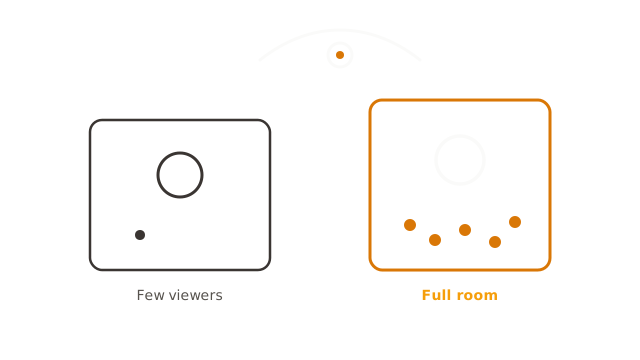
1. You're Streaming at the Wrong Time
This is the single most common and most impactful mistake new models make. Cam platforms have predictable traffic peaks that vary significantly by region and day of week. Streaming during off-peak hours means you're competing for a fraction of the available active viewers — and the platform algorithm has less traffic to push your room into.
Most new models stream when it's convenient for them personally. The viewers they're trying to reach are often in a completely different time zone. A model in Eastern Europe targeting North American viewers who streams at 8pm local time is streaming at 1pm Eastern — well before the US peak traffic window.
Fix: Identify your target audience's region and build your schedule around their peak hours. See our streaming times by region guide for specific windows.
2. Your Tags and Category Are Wrong
Platform search works almost entirely on tags. If you're using generic, highly competitive tags — the ones every model in your category uses — you're effectively invisible in search. You're competing with thousands of other rooms for the same keyword, and the algorithm will show established rooms with proven viewer history before yours.
The opposite problem is equally common: tags that are too specific or too unusual for anyone to search for. Neither extreme works.
Fix: Research which tags in your category have moderate competition — specific enough to be findable, common enough that viewers actually search them. Your category selection also matters: some categories have far less competition than others for the same type of content.
3. Your Preview Thumbnail Isn't Converting
On most cam platforms, viewers browse through a grid of room thumbnails before clicking into any room. Your thumbnail — the preview image or live snapshot of your room — is often the only thing a viewer sees before deciding whether to click.
A poor thumbnail loses potential viewers before they ever see you stream. Common thumbnail problems: bad lighting that makes the image look dark and unprofessional, an unflattering camera angle, a background that's visually cluttered or distracting, or a facial expression that reads as bored or uncomfortable.
Fix: Invest in basic lighting — even an inexpensive ring light dramatically changes how thumbnails look. Set up your camera angle intentionally. Check how your room appears in the platform's category grid before each session and adjust if needed.
4. You Have No Off-Platform Presence
Models who rely entirely on the platform algorithm for discovery have no floor on their viewership — every session starts from zero. When the algorithm isn't surfacing you, you get no viewers. Models with off-platform followings have a base of viewers who find out about their streams independently of platform ranking.
Twitter/X and Reddit are the two most important off-platform channels for most cam models. Both have active communities of cam platform viewers, and both allow you to post content that directs followers to your live streams.
Fix: Build at minimum a Twitter/X presence with consistent posting that includes when you're going live. Even a small off-platform following (200–500 followers) creates a meaningful difference in your first-viewer arrival during each session — which in turn improves your algorithmic ranking.
5. You're Not Streaming Consistently
Cam platform algorithms have a memory. Models who stream on a consistent schedule train both the algorithm and their audience. The algorithm learns when to expect your room to be live and can pre-warm its ranking. Viewers learn to plan for your streams.
Models who stream irregularly — different times, different days, unpredictable gaps — get treated by the algorithm as less reliable performers. More importantly, they never build the returning viewer habit. Returning viewers are the foundation of sustainable cam income.
Fix: Pick 3–5 streaming days per week and treat them as fixed commitments. Announce your schedule on your profile and on social media. Consistency compounds — viewers who know when you're live start planning their week around it.
6. Your Room Engagement Is Low
Most cam platforms factor room engagement — chat activity, tip frequency, viewer interaction — into how they rank rooms in category listings. A room where nobody talks, nobody tips, and the model doesn't engage with chat signals low quality content to the algorithm, even if the model is objectively good.
This creates a frustrating catch-22: you need engagement to rank, but you need ranking to get viewers to engage. Breaking out of it requires actively creating engagement even with small audiences.
Fix: Treat your chat as a community, not a side window. Respond to every message when you're small. Ask questions. Create small interactive moments — polls, challenges, decisions viewers can vote on. Even minimal engagement from 3–4 viewers looks very different to the algorithm than 10 silent lurkers.
7. You're New and the Algorithm Hasn't Calibrated to You Yet
Platform algorithms take time to understand a new account. In the first 4–8 weeks of consistent streaming, the algorithm is learning: who watches you, how long they stay, what they respond to, which audience segments engage most. It doesn't know yet who to show your room to.
This is normal and expected. The problem is that most models interpret this period as evidence that they're failing — and either quit or switch strategy before the algorithm has had time to calibrate. Consistency during this phase is more important than any tactic change.
Fix: Give the algorithm at least 6–8 weeks of consistent, strategic streaming before drawing conclusions. Track your metrics week-over-week, not day-over-day. Early trends are noisy; the pattern over 6+ weeks tells you the real story.
8. You're in a Saturated Niche Without Differentiation
Some cam categories have thousands of models streaming simultaneously at peak hours. In a category that crowded, a new model with no established audience and no clear differentiation has virtually no reason to attract viewers over established performers with years of history and existing fan bases.
"Being good" isn't a differentiator because every model in the category is already good enough. Viewers choose rooms based on identity, vibe, community, and consistency — not raw performance quality.
Fix: Define what makes your room specifically worth choosing over any other. This doesn't require being a completely different type of performer — it requires having a clear personality, aesthetic, or community identity that viewers can recognize and return to. A niche within a niche almost always outperforms generic positioning in crowded categories.
The Common Thread
Almost all low-viewer problems come back to the same root cause: streaming without a strategy. Good content is necessary but not sufficient. The models who consistently grow an audience treat streaming as a business — with a schedule, a positioning strategy, an off-platform presence, and regular review of what's actually working.
If you've identified multiple issues from the list above, start with timing and profile optimization — they have the highest leverage and lowest effort. Then build from there.
Frequently Asked Questions
How long does it take to fix a low-viewer problem?
Timing fixes and profile fixes can show results within 1–2 weeks. Building an off-platform presence takes 4–8 weeks to become meaningful. Algorithmic calibration takes 6–8 weeks of consistent streaming. Most models who apply all fixes simultaneously see clear improvement within 4–6 weeks.
Does the time of day really matter that much?
Yes — streaming during peak hours vs. off-peak hours can mean the difference between competing for 10,000 active viewers and competing for 1,000. At small audience sizes, this difference is often the entire margin between getting viewers and getting none.
I have some viewers but they never tip. Is that a different problem?
Usually, yes. Low viewers and low tips have partially overlapping but different causes. Tipping behavior relates more to community development, audience loyalty, and in-stream engagement techniques than to the discovery factors that drive raw viewer count.
Want Help Diagnosing Your Specific Situation?
We offer free profile audits as part of our onboarding process. Send us your profile and current streaming situation and we'll identify the highest-leverage fixes for your specific case.